
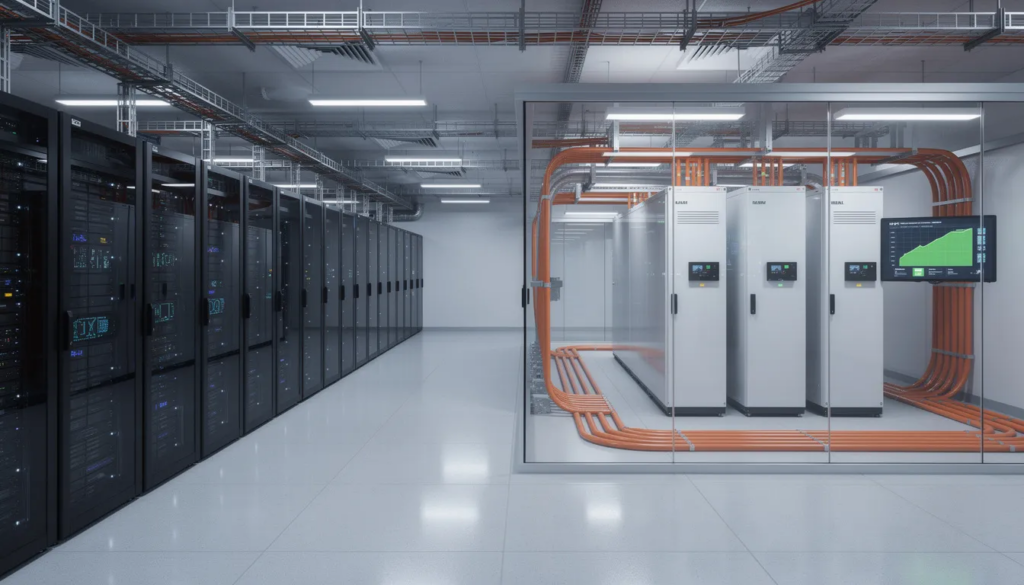
Data centers are becoming the core infrastructure of the modern economy, but many data center operators still rely on diesel generators as the default backup power solution. That approach may have worked for traditional data centers, yet it increasingly fails modern data centers where uptime, power quality, and sustainability targets are non-negotiable.
As hyperscale data centers, cloud data centers, and AI data centers expand across Europe, diesel backup is no longer just “legacy equipment”. It becomes a measurable risk: emissions, noise, fuel logistics, compliance pressure, and poor efficiency during frequent power outages. For data centers that run data intensive workloads and support artificial intelligence, stable power supply and predictable energy consumption matter more than ever.
The question for data center infrastructure in 2026 is not whether diesel still works. The question is: why are data centers still accepting a backup power model that is expensive, slow, and structurally incompatible with green data centers and modern grid requirements?
What are data centers and why power matters
Data centers are facilities designed to store data, run computing resources, and deliver digital services at scale. Whether it is a single data center site or multiple data centers connected by network infrastructure, every data center depends on constant electrical energy.
Unlike many industrial facilities, data centers cannot tolerate unstable power supply. A short power interruption can trigger server failures, cooling disruption, and significant outage costs. This is why uninterruptible power supply (UPS) systems are mandatory in enterprise data center design and colocation facilities.
Modern data centers are built around redundancy and system reliability. That means redundant capacity components, robust power distribution, high-quality storage systems, and strict control systems for monitoring operations.
Types of data centres: hyperscale, cloud, edge, and enterprise
Not all data centers are the same, and backup power strategies differ by segment.
Hyperscale data centers
Hyperscale data centers are large data center facilities built for cloud providers and high-volume computing. These sites handle extreme energy consumption and require industrial-scale power supply planning.
Cloud data centers
Cloud data centers provide services data centers like storage, computing, AI services, and business critical data hosting. Cloud providers manage capacity across regions and depend heavily on system performance and network equipment reliability.
Edge data centers
Edge data centers reduce latency by placing computing close to end users. But edge data centers often operate in diverse physical locations with weaker grid reliability and higher exposure to power outages.
Enterprise data center
An enterprise data center is owned by one organization and typically integrated with internal IT teams and enterprise resource planning systems. These sites often use traditional infrastructure logic: diesel + UPS, even when modern alternatives outperform it.
Traditional data centers vs modern data centers services
Traditional data centers were built with a “diesel-first” mentality. Modern data centers are built for efficiency, sustainability, and future-proof compliance. That shift makes diesel increasingly unacceptable.
Diesel generators in data centers: why this model is breaking
Diesel generators remain common in physical data centers because they were historically cheap to buy and easy to justify as emergency backup power. But the real world performance is ugly.
1) Slow response during power outages
Diesel generators need time to start. Even with ATS switching, there is still delay, instability, and dependence on UPS bridging. For data center operators, milliseconds matter.
2) Fuel logistics and failure points
Diesel backup requires diesel fuel storage, fuel supply contracts, refueling procedures, and risk management. Every extra “moving part” increases operational failure probability.
3) Poor efficiency at partial load
Data centers rarely operate backup systems at full rated capacity. Diesel runs inefficiently at partial load, increasing fuel burn and maintenance cost.
4) Emissions and regulatory pressure
Many data centers now commit to carbon reductions. Running diesel contradicts green data centers strategy, increases reporting burden, and exposes operators to future restrictions.
5) Maintenance burden
Diesel is not “set and forget.” It requires testing, servicing, and fuel quality management. This is operational debt.
Uninterruptible power supply: why UPS is not enough anymore
Uninterruptible power supply (UPS) is designed to ride through short outages and enable clean switching. UPS systems deliver stable electrical energy instantly and protect sensitive data security and computing resources.
But UPS is not a full backup solution.
UPS systems are typically sized for minutes, not hours. In modern data centers with frequent grid issues, UPS becomes a cost center. It also can’t fix the core problem: diesel dependency.
UPS should remain a protection layer, but the backup model must evolve.
Battery storage and modern backup power for data centers
Battery energy storage systems are already part of UPS logic. The difference is scale: modern battery storage can deliver hours of backup power, not minutes.
For data centers, battery storage systems solve multiple problems at once:
immediate backup power (no startup delay)
stable power quality and frequency control
ability to optimize peak loads and energy consumption
lower operational complexity
major energy efficiency gains at system level
Battery storage can also support grid services (depending on regulation), enabling additional ROI instead of sitting idle.
Hybrid backup: the realistic transition model
Many data center operators will not delete diesel overnight. The smarter path is hybrid:
battery storage carries instant response + short duration
diesel is reduced to last resort
control systems decide optimal dispatch
UPS integrates seamlessly into the power chain
This creates a stable power supply architecture where diesel use falls dramatically.
Hybrid backup reduces fuel burn, reduces maintenance, and improves system reliability.
Cooling systems, energy efficiency, and the hidden power problem
Data centers do not only consume power for computing. Cooling systems are one of the biggest loads in modern data centers, especially in AI data centers and hyperscale data centers.
Battery storage can stabilize cooling loads during grid fluctuations, preventing thermal swings. Diesel cannot react smoothly to fast ramping demands.
For energy efficiency, batteries integrate into modern controls better than diesel, enabling optimized operation at the facility level.
Data center security: physical security and data security depend on power
Data centers must protect sensitive data. That requires:
physical security and access control
continuous monitoring
fire suppression systems
secure network infrastructure
During power outages, security systems must remain functional. Any backup power design that introduces unstable switching increases risk.
Battery backup improves continuity for security systems and reduces the chance of cascading failures.
Grid reliability: the new constraint for data centers
Data centers grow fast, but grid expansion doesn’t. Many regions experience connection delays, grid congestion, and unstable supply. This forces data center operators to think beyond “backup”.
Battery storage allows:
demand smoothing
peak shaving
improved grid interaction
reduced curtailment risk
better site scalability
This is why many modern data centers now treat storage systems as core infrastructure, not optional hardware.
Conclusion: Data centers must stop hiding behind diesel
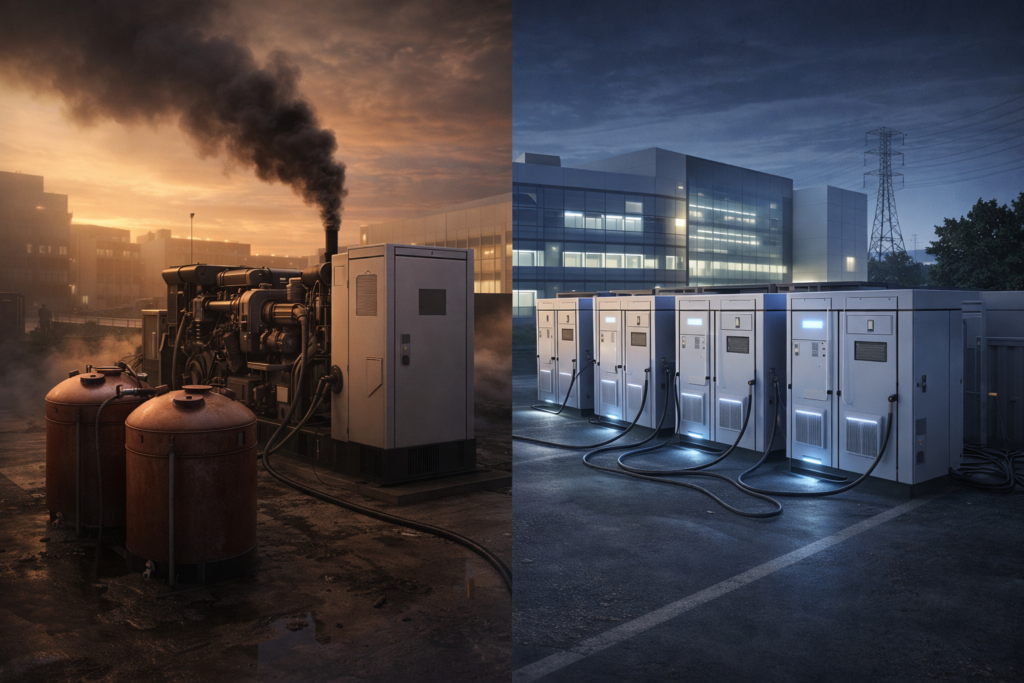
Data centers are the backbone of the digital economy. But diesel generators are the worst possible symbol of the future: expensive, dirty, slow, and operationally fragile.
Modern data centers, cloud data centers, hyperscale data centers, and edge data centers need backup power that matches the reality of 24/7 digital demand. Battery storage and hybrid models provide that: instant response, stable power quality, scalable system performance, and better energy efficiency.
Diesel will not disappear tomorrow. But for data center operators who want reliability, cost control, and long-term compliance, the future is clear: reduce diesel, expand battery storage, and redesign backup power around modern energy infrastructure.
Related Products from Aema ESS
Explore Aema ESS energy storage solutions for backup power, grid support, and renewable energy integration.
Featured systems:
Contact us today to receive a tailored offer for your upcoming project.