
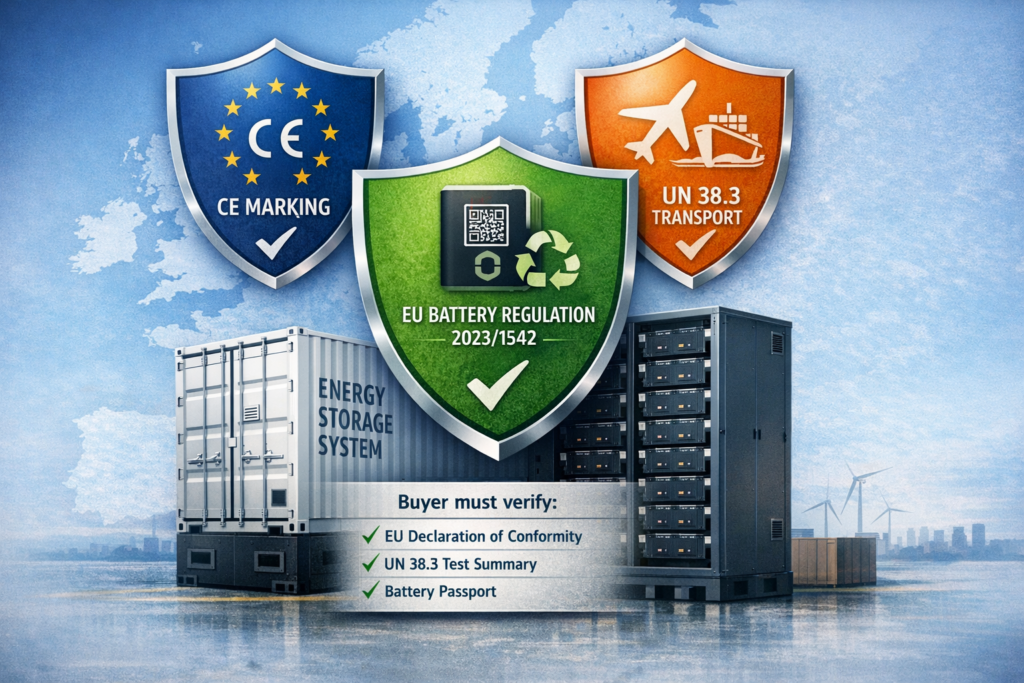
The CE mark is a legal declaration that the product complies with applicable EU legislation and demonstrates conformity with EU safety, health, and environmental protection requirements. Under the EU Battery Regulation (EU) 2023/1542, manufacturers placing batteries on the EU market must affix the CE marking from 18 August 2024, before the battery is placed on the market or put into service. This typically includes compliance with the Low Voltage Directive (2014/35/EU), the EMC Directive (2014/30/EU), and, where applicable, the Machinery Regulation (EU) 2023/1230.
For an energy storage system, CE conformity covers:
electrical safety: insulation, grounding, overcurrent and short-circuit protection
electromagnetic compatibility (EMC): no harmful interference with grid, BMS/EMS, or control systems
mechanical stability: cabinet/container integrity, mounting, access protection, and safe enclosure design
A genuine CE declaration must:
identify the manufacturer and the importer / authorised representative within the EU
list applicable harmonised standards (EN 62485-2, EN 61000-6-2, EN 61000-6-4, etc.)
include the name and signature of a responsible person authorised to sign on behalf of the manufacturer
Buyer rule: never accept a CE label alone. Request the full EU Declaration of Conformity and the referenced test reports (or technical documentation). If the supplier claims “self-declaration” but cannot provide traceable test evidence or a technical file, assume the compliance is not real and the liability will shift to you.
UN 38.3, transport safety for lithium and portable batteries
Before a single cell crosses a border, it must comply with the UN Manual of Tests and Criteria, Part III, Subsection 38.3 (UN 38.3). This confirms the battery can survive vibration, shock, temperature extremes, external short-circuit, and low-pressure altitude conditions during transport.
Key points:
Required for every cell, module, and pack shipped by air, sea, or land.
Testing documentation is issued by accredited labs (TÜV, SGS, Intertek, etc.).
Each certified product must have an official UN 38.3 Test Summary (mandatory under updated UN rules and industry practice for shipments since 2022).
Buyer rule: request the official UN 38.3 Test Summary with product ID, sample reference, and test lab details/signature. If a supplier cannot produce it instantly, assume the goods are either untested or being shipped non-compliantly.

EU battery regulation 2023/1542. battery passport, traceability and end-of-life responsibility, ce marking, battery saftey
The EU Battery Regulation (EU) 2023/1542 applies to batteries placed on the market or put into service in the European Union from 17 August 2023, with obligations becoming applicable in progressive stages starting from 18 February 2024. It replaces the old Battery Directive and shifts compliance from simple “product safety” to full lifecycle responsibility: sustainability, traceability, and recycling.
The regulation introduces clear battery categories and assigns different requirements and deadlines to each battery type:
portable batteries
industrial batteries (including stationary energy storage systems)
automotive batteries
electric vehicle (EV) batteries
light means of transport (LMT) batteries
For energy storage systems, the most critical parts of compliance are traceability, documentation, and end-of-life responsibility
Main obligations buyers must understand
Carbon footprint declaration: manufacturers must disclose lifecycle CO₂ intensity per kWh of capacity. Key timelines apply by battery type (for example industrial rechargeable batteries >2 kWh become effective from 18 February 2026).
Recycled content: minimum recycled content requirements apply in later stages. From 2031, minimum shares are mandatory for new industrial and EV batteries (commonly referenced targets include cobalt 16%, lithium 6%, nickel 6%, lead 85%).
Digital Battery Passport: for EV, LMT, and industrial batteries >2 kWh, a battery passport becomes mandatory from 18 February 2027, linked to a QR/RFID identifier with key data (chemistry, origin, capacity, compliance and recycling instructions).
Extended producer responsibility (EPR): end-of-life collection and recycling obligations apply under the regulation. The responsible EU economic operator must ensure compliant take-back and recycling processes.
Due diligence obligations: larger operators must implement battery due diligence policies for responsible sourcing and supply chain risk management, with external verification timelines applying in later stages.
Enforcement: member states must set penalties and enforcement systems (implementation timelines apply from 2025 onward).
Buyer rule: if you import, place the system on the EU market, or own the asset inside the EU supply chain, you can become the economic operator under the EU Battery Regulation. Require traceable production data and contractual clauses assigning EPR and compliance responsibility to the manufacturer or authorised EU importer/representative.
Digital battery passport: new requirements for traceability and transparency
The EU Battery Regulation (EU) 2023/1542 introduces the digital battery passport as a cornerstone requirement for traceability and transparency across the entire battery life cycle. The goal is simple: every battery placed on the EU market should carry a digital record that supports sustainability, compliance, and accountability from production to end-of-life recycling. This is part of the EU strategy to strengthen environmental protection requirements, reduce risks in supply chains, and accelerate a circular economy in the battery industry.
In practice, the digital battery passport is linked to a QR code (or RFID identifier) and gives structured access to relevant information for economic operators and end users. It improves transparency across the battery supply chain, making it easier to verify where the battery came from, what it contains, and how it must be handled and recycled.
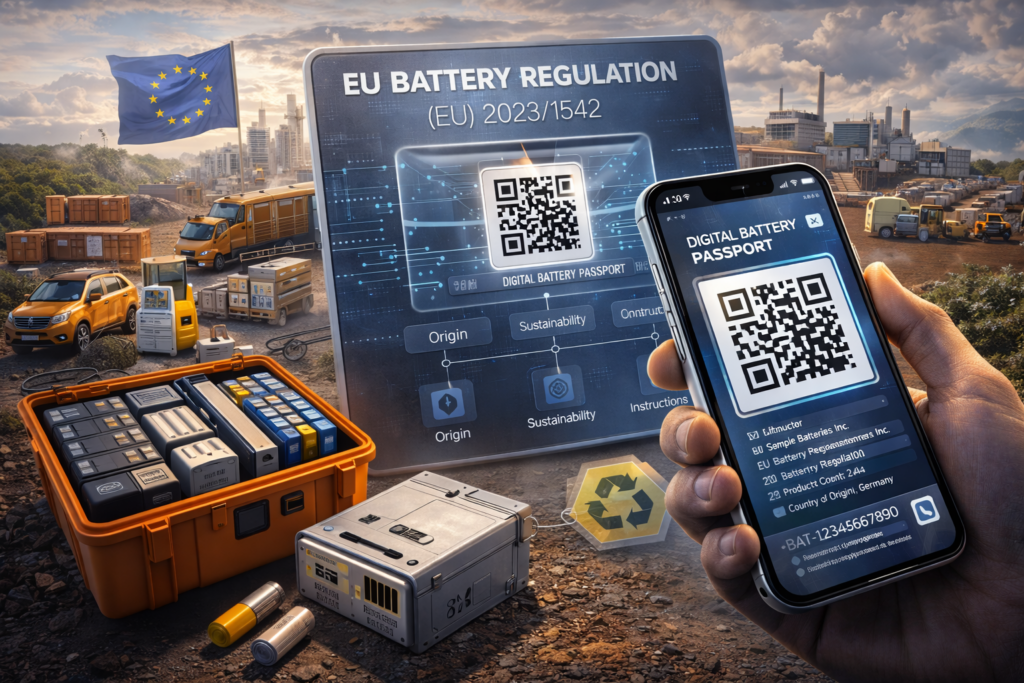
What information the battery passport includes
Each digital battery passport provides standardized data such as:
battery identification (category, model, and type)
technical details (chemistry, capacity, and performance parameters)
origin and traceability of key inputs and raw materials
sustainability information, including recycled content and carbon footprint-related declarations where applicable
compliance information and safe handling instructions
recycling and end-of-life guidance to support proper battery waste management
This ensures that batteries, including portable batteries, industrial batteries, electric vehicle (EV) batteries, and light means of transport (LMT) batteries, can be tracked throughout the entire battery lifecycle.
Why it matters for compliance and due diligence
The battery passport also supports due diligence obligations by increasing transparency on raw material sourcing, environmental impact, and social risks. It enables compliance checks across the supply chain and helps economic operators demonstrate responsible sourcing under EU rules. Where required, passport data and reporting can be subject to verification processes involving notified bodies, particularly as enforcement standards tighten.
Buyer takeaway
For manufacturers and importers, the digital battery passport is essential to demonstrate compliance with the new EU battery regulation. For buyers and operators, it is a practical risk filter. A storage system without an accurate battery passport and traceable compliance data can trigger delays at customs, create insurance exclusions, and block financing even if the hardware itself is technically strong.
Who is legally responsible
Manufacturer: responsible for CE conformity and UN38.3 testing.
Importer or Authorised Representative: responsible for ensuring compliance documents are valid and available in the EU.
Buyer / Operator: responsible for using the system as declared and for end-of-life handling under the Battery Regulation.
If any link fails, the last one holding the asset bears the legal burden.
In short: if you buy directly from China without an EU importer, you are the importer.
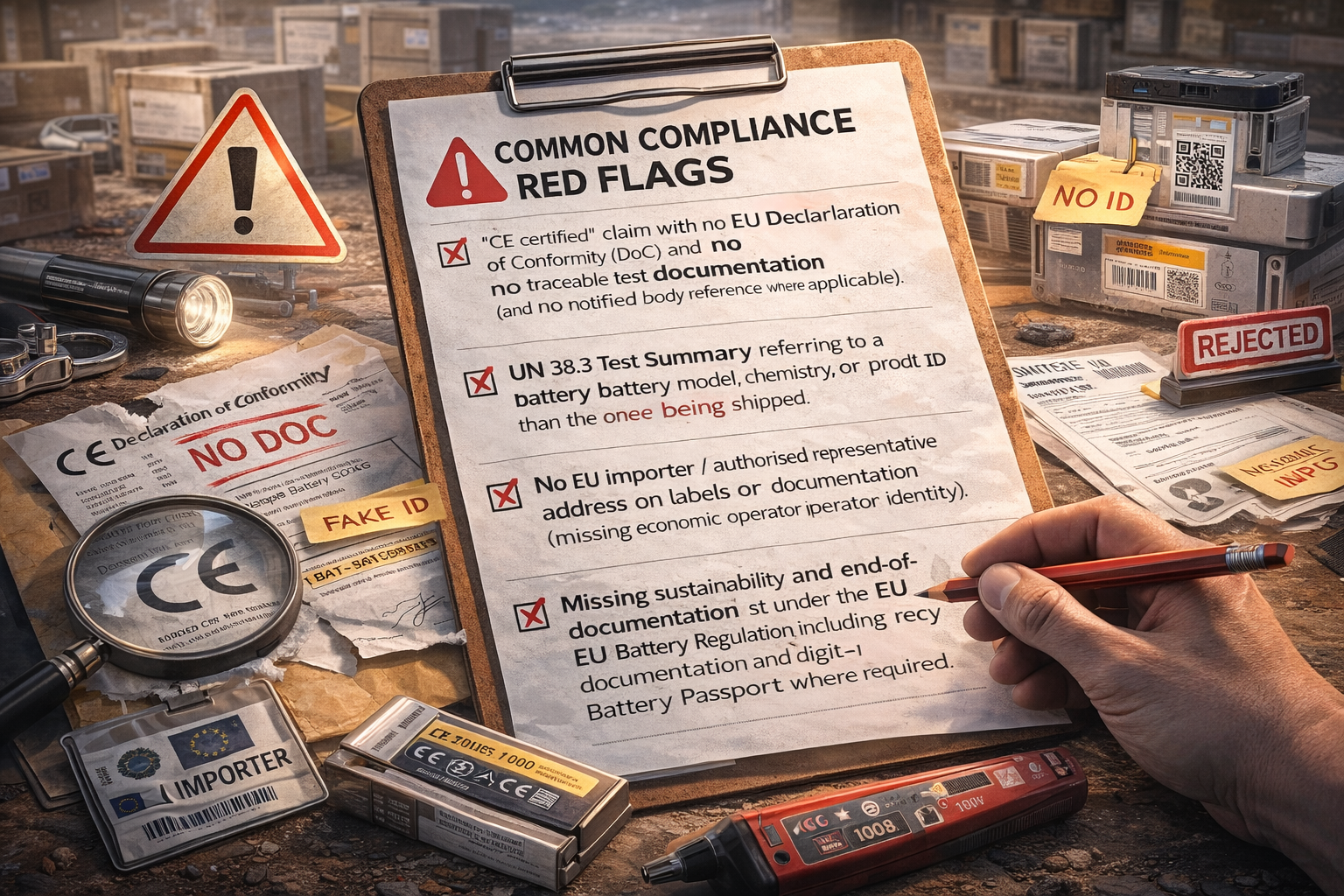
Common compliance red flags
“CE certified” claim with no EU Declaration of Conformity (DoC) and no traceable test documentation (and no notified body reference where applicable).
UN 38.3 Test Summary referring to a different battery model, chemistry, or product ID than the one being shipped.
No EU importer / authorised representative address on labels or documentation (missing economic operator identity).
Missing sustainability and end-of-life documentation under the EU Battery Regulation, including recycling documentation and the digital Battery Passport where required.
Each of these failures can block customs clearance, stop commissioning, invalidate warranty and insurance coverage, or trigger penalties under EU customs and environmental enforcement.
Why It Matters not only for battery safety but financially
A non-compliant energy storage system cannot be legally commissioned, insured, or financed. In practice, banks, leasing firms, and project finance lenders increasingly require verified compliance documents before funding is approved:
EU Declaration of Conformity (CE marking / CE compliance)
UN 38.3 Test Summary (often referred to as UN38.3 certificate in the market)
digital Battery Passport and recycling documentation under the EU Battery Regulation (EU) 2023/1542
If any part of this compliance package is missing, insurers can exclude coverage, lenders can refuse financing, and grid operators can block connection.
Ignoring compliance is not saving money. It is buying risk with compound interest.
Summary
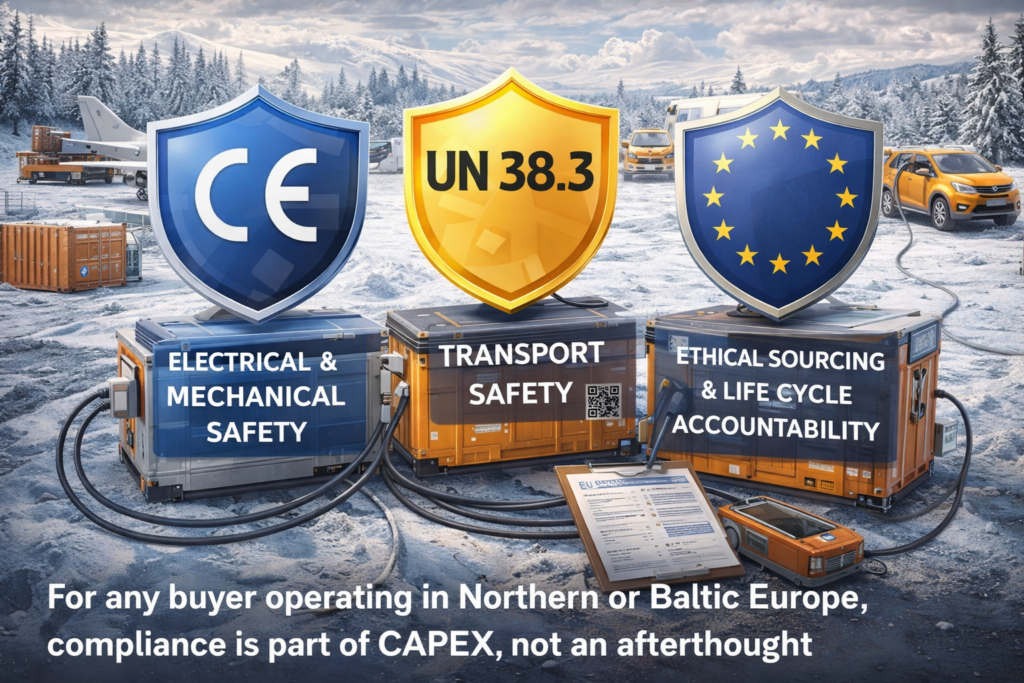
CE proves electrical and mechanical safety.
UN38.3 proves safe transport and handling.
EU Battery Regulation proves ethical sourcing and lifecycle accountability.
For any buyer operating in Northern or Baltic Europe, compliance is part of CAPEX, not an afterthought.
Related Products from Aema ESS
Explore Aema ESS energy storage solutions for backup power, grid support, and renewable energy integration.
Featured systems:
Contact us today to receive a tailored offer for your upcoming project.