
This one-page glossary is a collection of key terms and specialized terminology commonly used in energy storage systems and battery projects. It is designed as a dictionary-style reference that helps readers understand the meanings and technical vocabulary frequently found in datasheets, reports, and engineering documents. Where relevant, entries include brief context notes and examples to make complex concepts easier to interpret and apply in real-world projects.
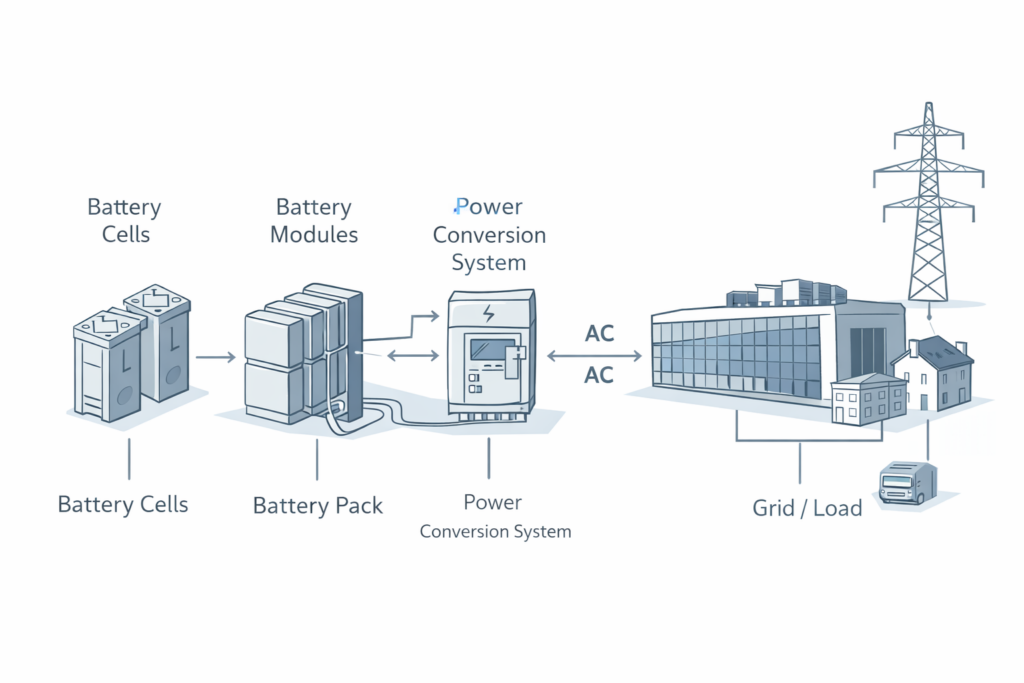
Battery terminology content in alphabetical list
Anode
Definition: Negative electrode where lithium ions are released during discharge.
Explanation: The anode’s surface chemistry strongly influences degradation and cycle life.
Balancing
Definition: Process of equalising voltages across cells to maintain uniform state of charge.
Explanation: Balancing prevents weak cells from limiting usable capacity and power.
Battery cells
Definition: Individual electrochemical units inside a battery system (cells are the building blocks of modules).
Explanation: Cell quality and consistency determine performance, warranty risk, and throughput.
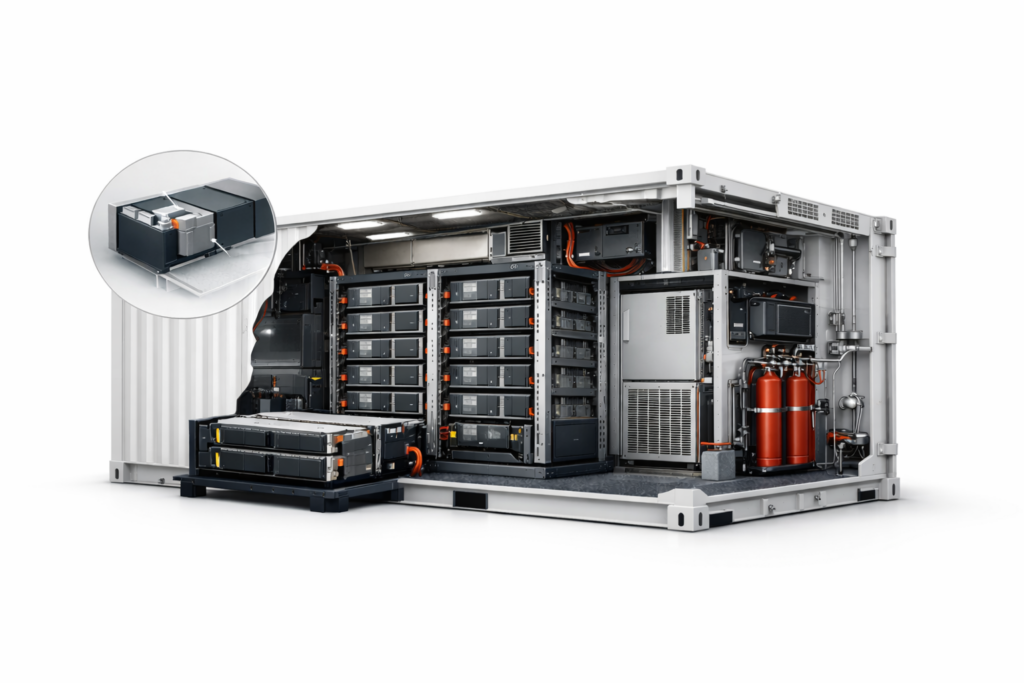
Battery Energy Storage System (BESS)
Definition: Fully integrated system consisting of battery packs, power electronics, control units, and auxiliary systems for charging and discharging electrical energy.
Explanation: BESS is the system-level product used in projects for grid stability and commercial dispatch.
Battery management system (BMS)
Definition: Electronic unit that monitors cell voltages, currents, and temperatures, balancing charge and providing protection.
Explanation: The BMS is responsible for safety and for enforcing voltage windows and current limits.
Battery pack
Definition: Complete battery assembly including modules, cabling, sensors, and thermal interfaces.
Explanation: Packs are the deployable units integrated into racks and containers.
Calendar life
Definition: Time-based aging of a cell independent of cycle count, mainly affected by temperature and voltage.
Explanation: Calendar aging matters even when the battery is not cycling.
Cathode
Definition: Positive electrode where lithium ions are inserted during discharge.
Explanation: Cathode chemistry affects energy density, safety, and long-term stability.
C-rate
Definition: Charge or discharge rate relative to nominal capacity (1C = full charge/discharge in one hour).
Explanation: Higher C-rate enables fast response but increases stress and heat.
Cell
Definition: Basic electrochemical unit converting chemical energy into electrical energy through oxidation and reduction reactions.
Charge acceptance
Definition: Ability of a cell to accept charge at a given current without exceeding limits.
Explanation: Charge acceptance declines with aging and temperature extremes.
Charge profile
Definition: Pattern of voltage and current during the charging process.
Explanation: Profiles are designed to maximise lifetime and avoid lithium plating.
Current limit
Definition: Maximum allowable current during charge or discharge to avoid degradation.
Explanation: Exceeding limits increases heating and accelerates aging.
Cycle life
Definition: Number of complete charge-discharge cycles before usable capacity drops below a defined limit.
Explanation: Cycle life depends on temperature, DoD, and C-rate.
Depth of discharge (DoD)
Definition: Percentage of total capacity removed during a cycle.
Explanation: Higher DoD increases usable energy but accelerates degradation.
Example: 90% DoD typically reduces lifetime compared to 70–80% DoD.
Discharge profile
Definition: Pattern of current draw and voltage drop during discharge.
Explanation: Load profile affects heating, efficiency, and aging rate.
Electrolyte
Definition: Ion-conducting medium allowing transport of lithium ions between electrodes.
Explanation: Electrolyte stability impacts safety and cycle life.
Energy density
Definition: Amount of energy stored per kilogram or per litre of battery material.
Explanation: Higher energy density reduces footprint but may increase thermal risk.
Formation process
Definition: Initial controlled charge cycles during cell manufacturing to build the SEI layer.
Explanation: Formation quality impacts lifetime and safety performance.
Gas generation
Definition: Release of gases during side reactions, typically at high voltage or temperature.
Explanation: Gas generation can swell cells and trigger safety events.
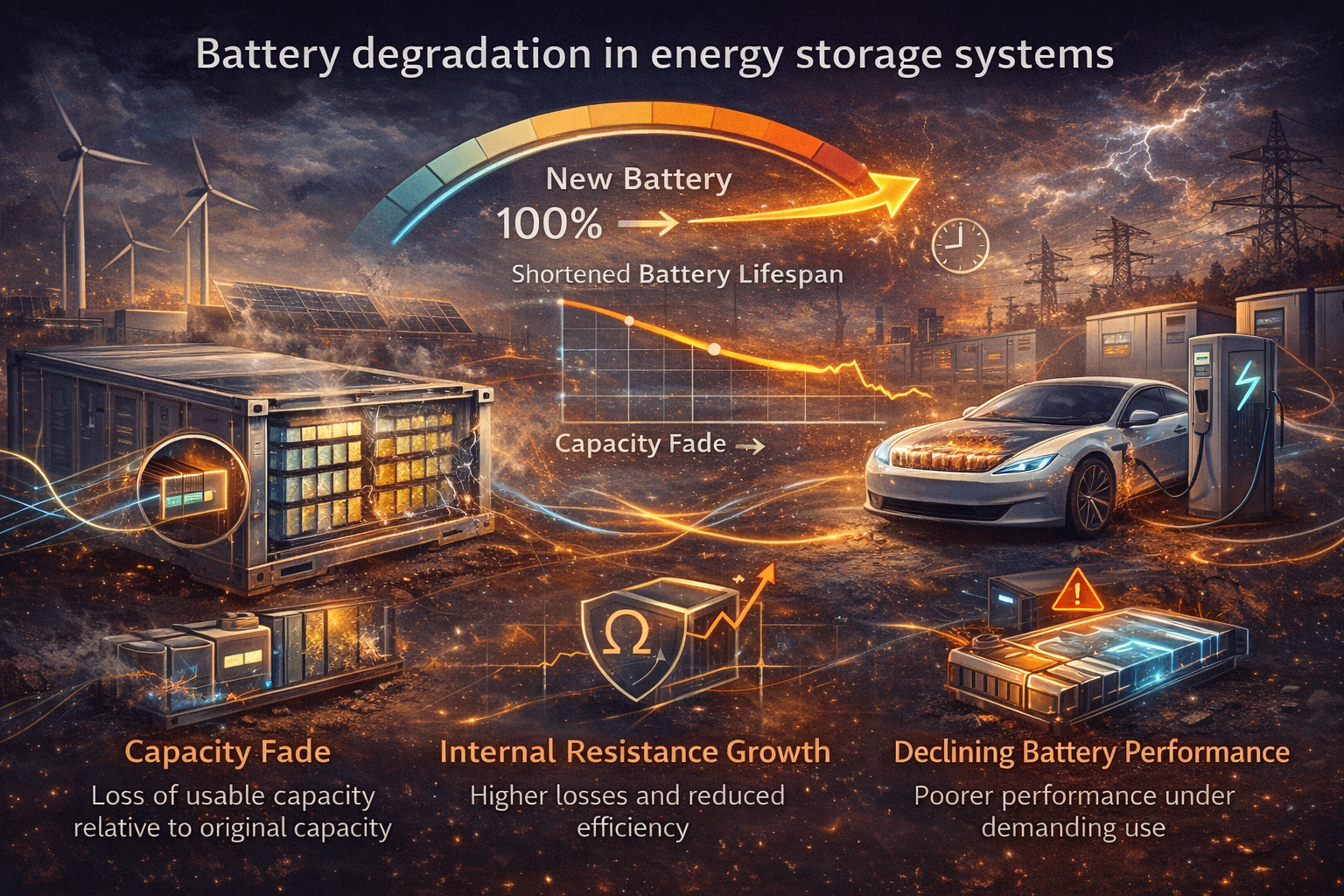
Impedance growth
Definition: Increase of internal resistance over time due to aging and side reactions.
Explanation: Impedance growth reduces power capability and increases heating.
Internal resistance (IR)
Definition: Resistance inside a cell determining power capability and heat generation.
Explanation: Higher IR reduces efficiency and limits peak power.
Module
Definition: Group of cells connected in series or parallel and placed in a mechanical frame with sensors and protection.
Explanation: Modules make handling, maintenance, and safety monitoring easier.
Nominal capacity
Definition: Rated energy content available under standard conditions.
Explanation: Nominal capacity is not equal to usable capacity in real operation.
Nominal voltage
Definition: Average working voltage of a cell or module used for design and rating.
Explanation: Nominal voltage helps define system configuration and inverter selection.
Overcharge
Definition: Condition when voltage exceeds maximum specification, causing accelerated degradation.
Explanation: Overcharge increases fire risk and gas generation.
Overdischarge
Definition: Condition when voltage falls below safe minimum, risking irreversible damage.
Explanation: Overdischarge can destroy cells and reduce capacity permanently.
Passivation layer (SEI)
Definition: Protective film formed on the anode surface stabilising lithium-ion reactions.
Explanation: SEI formation is normal, but uncontrolled growth reduces capacity.
Power density
Definition: Amount of power delivered per kilogram or per litre.
Explanation: Power density matters in fast-response markets and grid services.
Rack
Definition: Structural frame containing several modules, busbars, monitoring circuits, and fuse.
Explanation: Racks define serviceability and thermal architecture of the container.
Separator
Definition: Microporous membrane keeping electrodes apart while enabling ionic flow.
Explanation: Separator quality directly affects safety.
Self-discharge
Definition: Natural energy loss when a battery is idle due to internal chemical reactions.
Explanation: All batteries lose energy over time, even at rest.
SOC window
Definition: Software-defined upper and lower SoC limits used to reduce aging.
Explanation: SOC window improves calendar life and reduces stress.
State of charge (SoC)
Definition: Proportion of stored energy in a cell or system compared to its total capacity.
Explanation: SoC is critical for dispatch planning and warranty compliance.
State of health (SoH)
Definition: Indicator of remaining performance compared to the initial state, based on capacity and internal resistance.
Explanation: SoH triggers warranty thresholds and replacement decisions.
Thermal gradient
Definition: Difference in temperature between areas of a cell or module affecting performance uniformity.
Explanation: Thermal gradients cause uneven aging and imbalance.
Thermal management system (TMS)
Definition: Subsystem controlling battery temperature through liquid or air cooling and heating.
Explanation: TMS increases safety, lifetime, and efficiency.
Throughput
Definition: Total energy processed over lifetime, measured in megawatt-hours.
Explanation: Throughput is a practical lifetime metric used in warranties.
Usable capacity
Definition: Practical capacity available within defined voltage and temperature limits.
Explanation: Usable capacity defines real project revenue, not marketing labels.
Voltage window
Definition: Safe operating range between minimum and maximum cell voltage.
Explanation: Operating outside the voltage window accelerates degradation and increases risk.
Related Products from Aema ESS
Explore Aema ESS energy storage solutions for backup power, grid support, and renewable energy integration.
Featured systems:
Contact us today to receive a tailored offer for your upcoming project.