
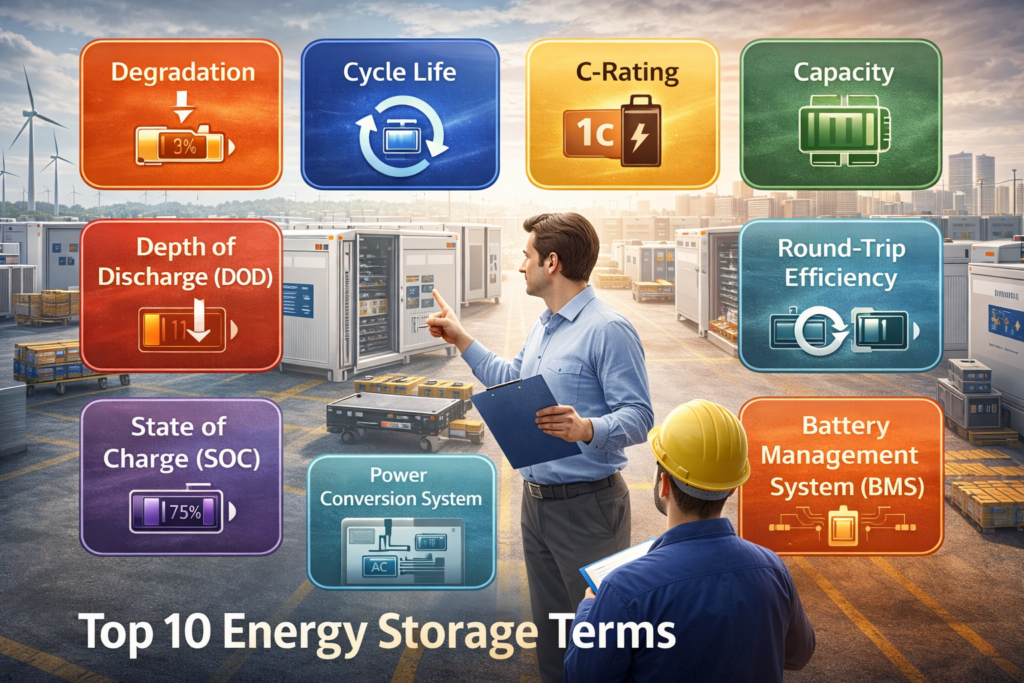
A buyer does not need to be an engineer, but must speak the same language as one. The top 10 energy storage terms define performance, warranty, and lifetime value in every commercial project. Learn them once, and you can read any battery energy storage system (BESS) datasheet or supplier pitch without guessing.
Energy Storage System Overview: Why Buyers Need a Common Language
Energy storage systems help store energy from renewable energy sources and release it when needed, improving grid stability and enhancing energy efficiency. Today, battery storage is the dominant solution, but the market is expanding toward long duration energy storage technologies such as pumped hydro, compressed air energy storage, liquid air energy storage, and thermal energy storage. These energy storage solutions support renewable integration for solar and wind power and reduce reliance on fossil fuels.
The energy storage landscape is evolving rapidly. Falling battery pack prices, policy support (including the Inflation Reduction Act), and the need for renewable energy integration are pushing the global energy storage market forward. The International Energy Agency tracks how energy storage trends accelerate the energy transition: more solar power generation, more solar panels, more wind and solar power, and therefore more need to store energy to keep grid stability and grid reliability.
Energy storage systems are deployed across utility scale energy storage sites and distributed energy storage systems. While lithium ion batteries dominate battery storage today due to higher energy density and high round trip efficiency, long duration energy storage technologies are expanding fast: pumped hydro, compressed air energy storage (CAES), liquid air energy storage, thermal storage, hydrogen storage, flow batteries (including vanadium redox flow batteries), and emerging chemistries such as sodium ion batteries, iron air batteries, and solid state batteries.
But none of that matters if you cannot judge the commercial offer. This list is the simplest way to understand energy storage technology, battery storage systems, and storage capacity without becoming an engineer.
1. State of charge (SoC)
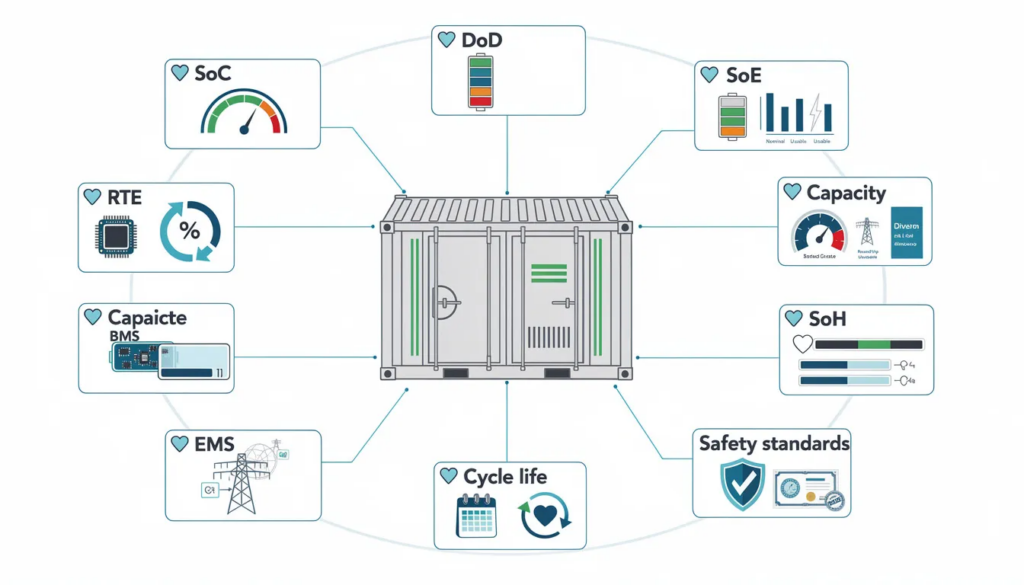
State of charge (SoC) shows how much energy is currently available in the battery, expressed as a percentage of total energy capacity. It tells you how much usable power remains before protection limits reduce output. In real projects, storage systems rarely operate from 0% to 100% SoC. Most battery energy storage systems (BESS) operate within a narrower window (for example, 10% to 90%) to protect battery cells and reduce degradation. Buyer note: If a vendor markets “100% usable,” verify operating SoC limits in the battery storage contract and warranty.
2. Depth of discharge (DoD)
Depth of discharge (DoD) is how much of the total capacity is actually used in each cycle. Higher DoD means more delivered energy per cycle, but also faster aging, especially for lithium ion batteries. Every manufacturer sets an optimal DoD range. Exceeding it can reduce cycle life and may affect warranty conditions. Buyer note: DoD defines economics: it drives delivered energy, degradation, and replacement schedule.
3. Round-trip efficiency (RTE)
Round-trip efficiency measures how much energy you get back compared to what you put in. If RTE is 90%, you lose 10% every time you charge and discharge. In battery storage systems, high round trip efficiency is a major value driver over the lifetime of energy storage projects. It impacts energy efficiency, electricity bills, and profitability in electricity markets. Buyer note: Always clarify whether RTE is AC-AC or DC-DC. This is a classic trick in supplier decks.
4. C-rate
C-rate defines how fast a battery charges or discharges relative to its nominal capacity. A 1C system can charge or discharge fully in one hour. A 0.5C system needs two hours. C-rate is a design choice: higher C-rate supports fast-response grid services, but increases thermal stress and can reduce lifetime. This is crucial for applications linked to grid scale energy storage and frequency services. Buyer note: Always align C-rate to the revenue model. Overpaying for power you do not use is a silent CAPEX leak.
5. Battery capacity (nominal and usable)
Nominal capacity is the total rated energy content (e.g., 500 kWh). Usable capacity is the energy you can safely draw (often 80-90% of nominal). The usable capacity determines the actual profit, not the nominal rating.
Energy capacity refers to the maximum amount of energy a storage system can hold, which is crucial for determining how long the system can deliver power and its operational flexibility. It is important to distinguish energy capacity from power capacity, which measures how quickly energy can be delivered.
6. State of health (SoH)
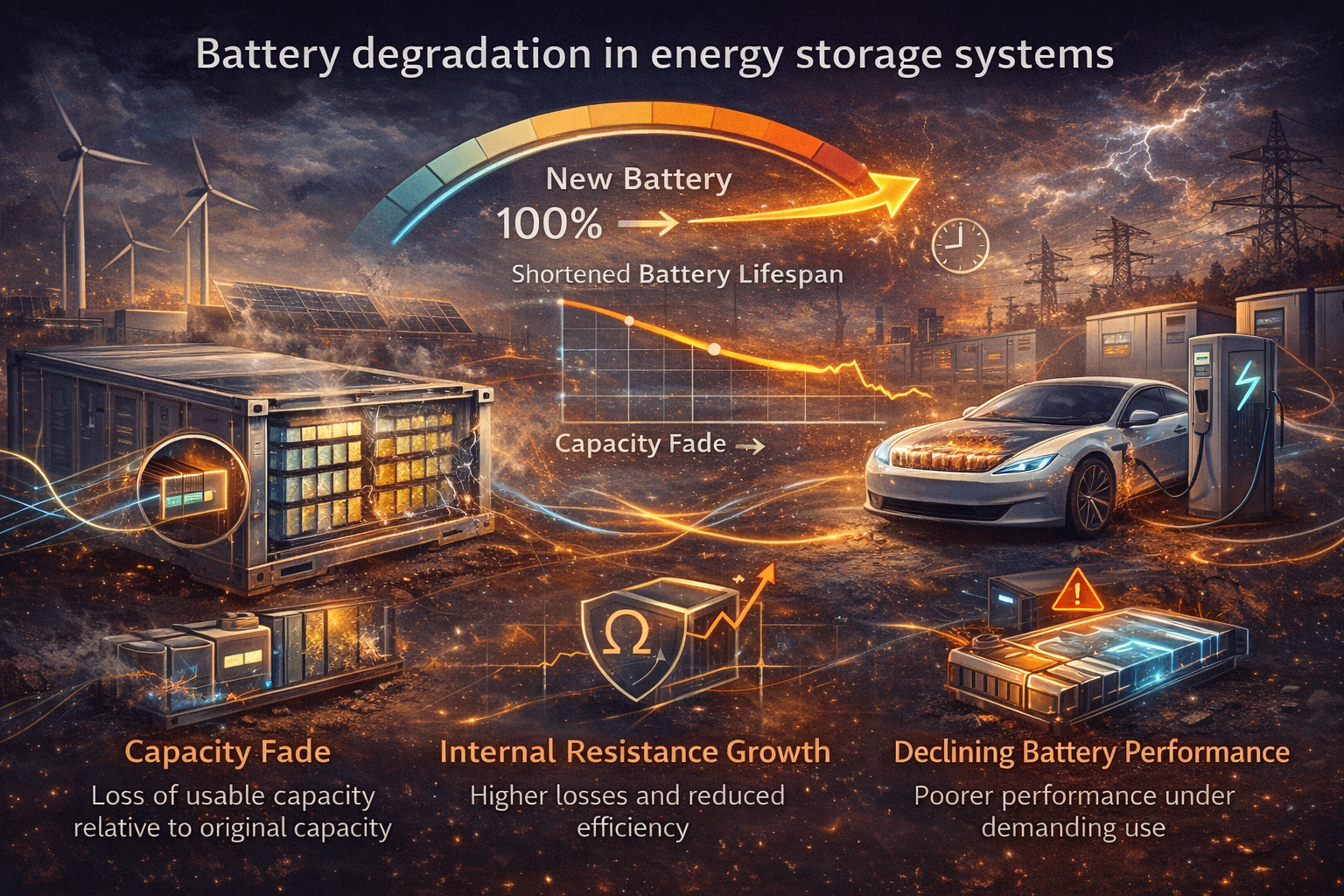
State of health shows how the system performs today compared to the original specification. It is the central warranty metric for battery storage and storage technology contracts. When SoH drops below the warranty trigger (often 70%–80%), warranty action may apply. SoH is affected by DoD, temperature, C-rate, and calendar aging. Buyer note: Ask for measurement method and reporting frequency. A vague SoH definition is a red flag.
7. Battery management system (BMS) in battery energy storage system
Battery management systems (BMS) are the control brain of the battery: monitoring temperature, voltage, and current in battery modules and battery cells. A solid BMS prevents unsafe states, improves lifetime, and supports compliance. In modern utility scale storage, BMS quality separates safe assets from thermal runaway risk. Buyer note: If the BMS looks like an afterthought, walk away. That is where failures start.
8. Energy management system (EMS)
The energy management system (EMS) controls dispatch: when to charge, discharge, trade, or hold energy. EMS links BESS to the grid, solar power, on-site generation, or hybrid energy storage systems. EMS quality directly affects returns through smarter dispatch and better response in electricity markets. It also enables participation in distributed energy storage systems, virtual power plant programs, and demand-side grid services. Buyer note: EMS is not “software decoration.” It is an ROI engine.
9. Cycle life
Cycle life counts how many full cycles the system can perform before dropping below warranty capacity. It depends on DoD, temperature, and C-rate. A system rated for 6,000 cycles at 80% DoD running one cycle per day delivers roughly sixteen years of operation. But real life depends on dispatch patterns in energy production, renewable energy sources, and grid stability needs. Buyer note: Ask for both cycle life and throughput warranty (MWh delivered). Throughput is harder to “massage.”
10. Safety and compliance standards
Every energy storage system must meet mandatory safety and compliance requirements before it can be insured, transported, permitted, or grid-connected. For battery energy storage systems (BESS), this includes CE conformity, UN 38.3 transport certification, and local fire-safety codes. In many markets, key standards include UL 9540 (energy storage systems and equipment) and UL 9540A (thermal runaway and fire propagation testing). These are not paperwork formalities: compliance determines whether a storage project can operate legally and whether insurers will accept the risk. Buyer note: A legitimate certificate always includes the testing laboratory name, a traceable report number, and a defined test scope – if the vendor cannot provide this, assume the documentation is not real.
Closing note
These top 10 energy storage terms turn a technical proposal into readable business language. When you understand them, you can evaluate storage systems based on lifetime value, not vendor promises. This is the bridge between the finance model and the engineer’s design, and the foundation of an informed buyer in the energy storage industry.
Related Products from Aema ESS
Explore Aema ESS energy storage solutions for backup power, grid support, and renewable energy integration.
Featured systems:
Contact us today to receive a tailored offer for your upcoming project.